
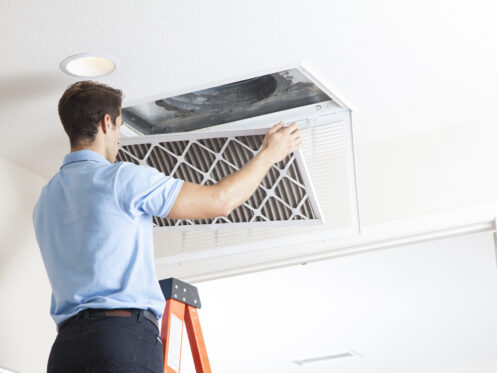
With allergy season approaching in the spring, many homeowners are gearing up for unpleasant symptoms like sneezing and congestion. Fortunately, there are many different things that you can do involving your HVAC system that can help to improve your indoor air quality. This can minimize your allergy triggers and symptoms alike.
There are many different allergens that can cause allergy triggers in your home. Pollen, dust mites, pet dander, mold spores, and even outdoor air particles all contribute to these issues. Unfortunately, many airborne toxins can easily enter your home through your doorways or on the fur of your pets. While there are some things you can do to help minimize the amount of pollutants coming into your home, you can’t avoid them entirely. This is why it’s so important to have a proactive plan in place before the spring season hits.
Change Your Air Filter
One of the absolute best things you can do is replace your dirty air filter with a new one. This is located right inside your HVAC’s return ductwork and can easily pop out. Ideally, you want to be checking this filter every month through the spring and summer to check when it gets dirty. Any time that the filter is so dirty you can’t see through it, it needs to be replaced with a new one.
When selecting a filter for your HVAC system, you need to choose one of the exact dimensions that are in it. A filter that’s too small won’t adequately filter your air. A filter that’s too big simply won’t fit in your filter’s housing. All filters have a rating on the MERV scale that indicates how effective they are at filtering airborne particles.
The higher the rating, the better filtration they offer. If you have allergies, we suggest choosing a filter rated between 11 and 13. This is a bit more expensive than your average pleated filter. However, it will severely cut down on your allergy symptoms while indoors.
Schedule HVAC Maintenance
Another must-do to prepare your home for allergy season is to schedule professional HVAC maintenance service. This service includes in-depth cleaning of the internal components of your air conditioning system. This ensures that there’s no stuck-on debris that could be reducing your air quality level.
It also verifies that your system is operating efficiently so that it can successfully filter particles out of the air. Our service includes sanitizing your drain pans and lines to prevent unwanted mold growth. Apart from ensuring optimal efficiency, this also maintains your warranty coverage and extends the lifespan of your AC unit.
Consider Duct Cleaning
Your ductwork plays a very important role in circulating air throughout your home. If there are leaks in your ducting, it can allow unwanted dust and other debris to enter your air from wall and floor cavities. Additionally, it’s important to note that your ducting will accumulate airborne particles over time. As they build up inside your ductwork, they’ll reduce your indoor air quality. This buildup will also restrict airflow, decreasing the performance of your system and leading to higher energy bills.
One of the most effective ways to get rid of this buildup is duct cleaning service. This is where we sanitize the entire inside of your ducting to get rid of any unwanted debris. We also recommend getting ductwork properly resealed to get rid of any air leaks that could be pulling in unwanted toxins from your wall and floor cavities. A properly sealed ducting system will enhance HVAC efficiency, allowing for more air filtration.
Control Indoor Humidity
Indoor humidity plays a key role in the development of unwanted toxic mold and mildew growth. If indoor humidity levels rise above 50%, it encourages mold and mildew growth in your home. There are a few different ways that you can best control indoor humidity. One of the most important things is running your exhaust fans whenever you’re cooking or taking a shower. This will divert excess steam, along with other airborne contaminants, out of your home. If you fail to use your exhaust fans, you could be letting unwanted humidity linger in your home.
Another potential option is investing in a whole-home dehumidification system. While it’s true that your air conditioner dehumidifies the air, a dehumidification system takes care of overly humid days. You can set your thermostat to anywhere between 30 and 50% humidity. If the humidity level exceeds 50%, your dehumidification system will automatically kick on to remove that excess humidity.
Seal Up Air Leaks
Air leaks hidden in your exterior walls can significantly reduce your indoor air quality level. One of the best things you can do is seal up those leaks to prevent unwanted air from outside from seeping into your home. You can locate these near door and window frames, as well as near light switches and outlets on your exterior walls.
Simply put your hand up to these locations and see if you notice a difference in temperature. If you do, you have an air leak. You can successfully seal up these air leaks with a variety of different materials, depending on the application. Some of the most commonly used include spray foam, caulking, and weather stripping.
Extended Media Filters
If you’re struggling with indoor air quality, even though you’re keeping up with routine filter changes, you may need to upgrade to an extended media filter. This is a much larger filter that gets installed inside your return ducting. Its job is to filter out more airborne contaminants than just your HVAC filter. For example, it has an activated carbon filter that will remove unpleasant odors to help improve your home comfort. These filters last much longer than traditional HVAC filters, usually around six months.
Whole-Home Air Purification System
Another great option is a whole-home air purification system. While this comes at a premium price, it will significantly enhance your indoor air quality. It’s great for those with severe respiratory conditions. There are a few different types of air purification systems that you can have installed alongside your HVAC unit.
One of the most popular includes UV sanitizing lights. These germicidal lights will disrupt the DNA of pathogens, viruses, and bacteria. This renders them unable to reproduce and causes them to die off. These can be placed inside your return ducting or at the evaporator coil inside your indoor air handler unit.
Electrostatic air cleaners, also known as electrostatic precipitators, are a specific type of air filtration technology. They use electric charges to remove particles from the air. These can be a great supplemental solution to your existing HVAC air filter to improve your indoor air quality. These units operate very quietly and require routine cleaning of their collection plates.
Reliable HVAC Maintenance Service
Ahoy! Cooling & Heating provides reliable HVAC maintenance service for Tampa, FL and the surrounding areas. We can also assist with all your HVAC repair, installation, and replacement needs. Call us today to book your next service appointment.